
Introduction by Bruce Bolinger
For the last sixteen years I have been researching the aid given to downed Allied airmen by the Resistance during World War II in The Netherlands, Belgium, and France. Most of my research has concentrated on three subjects:
- An American airman, Tom Applewhite, a bombardier on a B-17, “The Wild Hare,” who was shot down near Heusden, east of ‘s-Hertogenbosch (also known as Den Bosch), on 11 November 1943. Thanks to the aid of three escape and evasion lines, one Dutch and two Belgian, plus the British Embassy in Madrid, he reached the British naval base at Gibraltar two months later.
- A Dutch escape line, the Smit-van der Heijden Line, headed by Karst Smit, a marechaussee (Dutch Royal Military Police), stationed first in Hilvarenbeek and then in Baarle-Nassau, and his partner, Eugene Van der Heijden, a teacher from Hilvarenbeek. The two towns are located near the Belgian border.
- The story of Tina Lindeboom, who emigrated with her family to the U.S. at age 18 in 1929, returned to The Netherlands in 1936 to marry, hid airmen in her home in the southeastern part of Friesland, and returned to the U.S. in the 1971. She was awarded the Verzetsherdenkingskruis (Resistance Memorial Cross). For more details, see the Traces of War website at https://www.tracesofwar.com/sights/83557/Memorial-to-Tina-Lindeboom.htm.
The first two subjects are interrelated because Tom Applewhite was the last person to successfully pass through the Smit-van der Heijden Line. The next man in the line, Nello Malavasi, a member of the crew of “The Wild Hare,” and his guide, Willem Schmidt, were arrested by the Germans in Turnhout, Belgium, on 15 November 1943. This led to the rapid arrest of many members of the line and its destruction.
I became interested in these subjects for several reasons:
(1) My great-uncle, Arthur Schrynemakers, a Dutch national living in Brussels during the war, hid Tom Applewhite for over a month from November-December 1943, as well as two Jewish families and two members of the Luc-Marc intelligence line.
(2) Schrynemakers’ son, Arthur Britton, was responsible for the arrest of Heinrich Himmler.
(3) A cousin, Charles Henri Schrynemakers, was a member of Service D, a Resistance organization in Liege that, among other things, intercepted denunciations sent in the mail and warned people before the denunciations reached the Germans. As a mailman, Charles was ideally situated to participate in this. Later he was also involved in armed Resistance.
(4) Another cousin, Georges Moeren, was a member of the Forces Belges en Grande-Bretagne (Belgian Forces Great Britain) during WWII.
(5) My oldest first cousin, Ralph Hichens, was a top turret gunner and flight engineer on a B-17 in 1944. (For more on Hichens, see http://384thbombgroup.com/_content/_pages/person.php?PersonKey=1714. See also https://www.wwiimemorial.com/Registry/plaque.aspx?honoreeID=1649081.)
(6) A memorial to Tina Lindeboom is located in Nevada City, California, three miles from where I live in Grass Valley. See http://en.tracesofwar.com/article/83557/Memorial-to-Tina-Lindeboom.htm for further information.
Below is a photo of Ralph and the other members of the crew of the “Stag Party.” Click once on it to get an enlargement. Click a second time and it will enlarge even further.
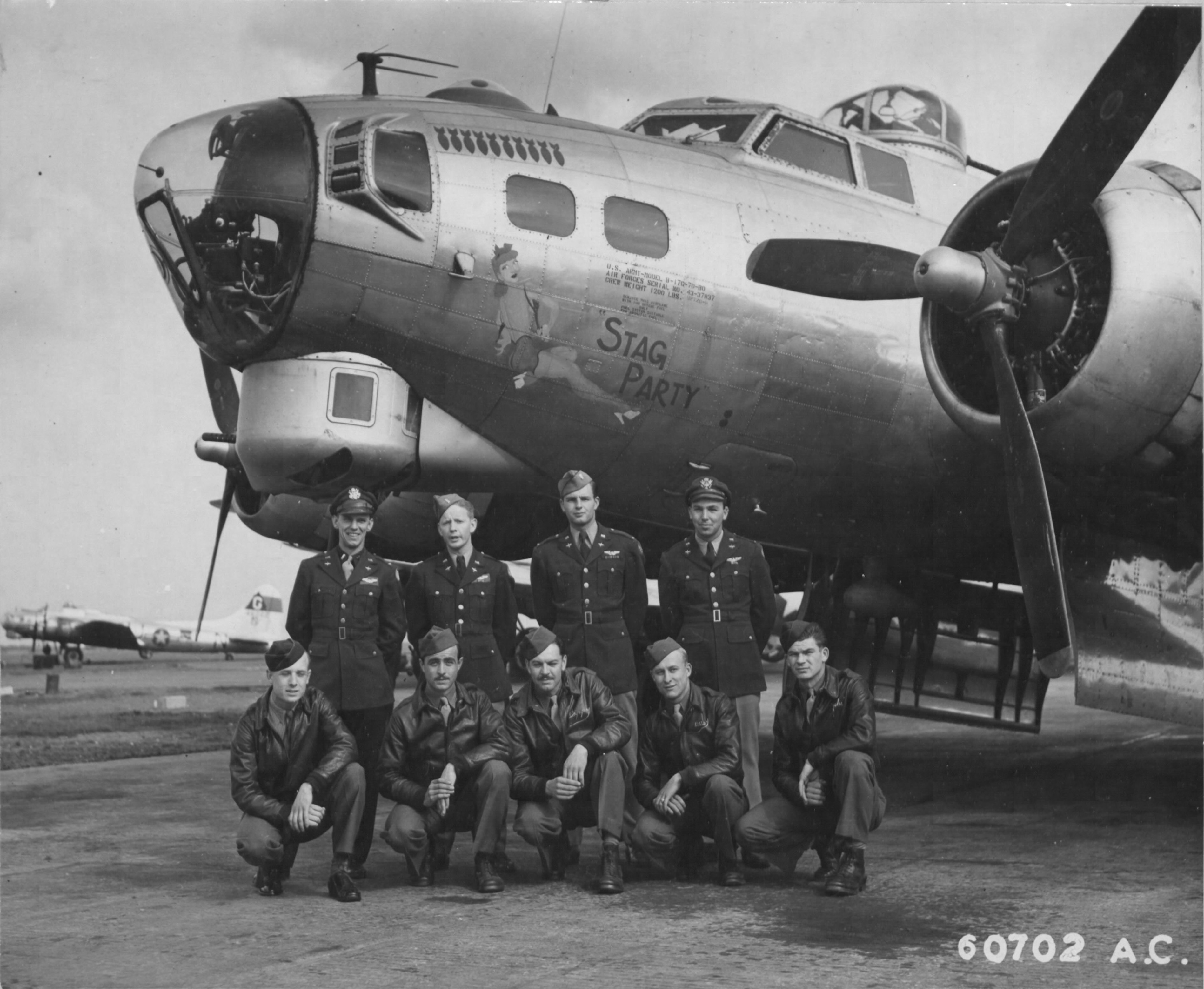
Back row from left to right:
- Pilot: Thomas H. “Pete” Fitzgerald
- Co-Pilot: Edward J. Bullitt
- Navigator:- Edwin M. Dexter
- Bombardier: Richard D. Eide
- Top Turret Gunner/Flight Engineer: Ralph “H” Hichens
- Radio Operator: Edward Gramc
- Tail Gunner: Edgar L. “Pappy” Heeg
- Ball Turret Gunner: Charles O. Beckham
- Waist Gunner: Michael Kimak
For additional pictures, see http://www.384thbombgroup.com/piwigo_384th_gallery/index.php?/category/2502.
This crew was originally assigned to the 384th Bomb Group/546th Bomb Squadron at Grafton Underwood where they flew 16 operational missions before being transferred to the 305th Bomb Group where they finished their tour. This picture was taken Sep. 21, 1944 at Chelveston when the crew was assigned to the 305th Bomb Group, 422nd Bomb Squadron. My thanks to my cousin, Greg Hichens, for providing the photo and the names of the crew.
Evolution of This Website
The original purpose of this website was to enable people with shared interests to contact me. But as I added material to it I realized that a second purpose would be to provide people who are doing their own research with some useful tools. Examples would be the advice on use of the Textual Research Room at the U.S. National Archives, the lists of Belgian and Dutch helper files by box number, the translation of the questionnaire used in The Netherlands for airmen, sources for information on aircraft crash sites, the directions on how to access the escape and evasion (E&E) reports online, the indexes to the lists of Dutch and Belgian/Luxemburger helpers, the list of passengers on the Nazi Ghost Train/Phantom Train, links to other useful websites, and two Frequently Asked Questions (FAQs), “What Did My Father/Grandfather/Uncle/Mother Do in the Resistance?” and “How Do I Learn About an Allied Airman Who Was Shot Down But Escaped?” Each FAQ has a variety of suggestions for research combined with links to sources.
The website was established March 31, 2010. At the outset I would have been happy with a few hundred hits (views). As of Dec. 31, 2021, 11 3/4 years after the establishment of the website, according to WordPress, the company that hosts this website, the cumulative total was 806,135 with the highest number any one month being January, 2014 with 10,376, and the highest any one day being Feb. 8, 2015 with 1,588.
By calendar year, the number of hits has been:
- 2010 15,373 (March 31-Dec. 31)
- 2011 38,939
- 2012 68,981
- 2013 90,206
- 2014 89,407
- 2015 88,115
- 2016 75,792
- 2017 78,042
- 2018 68,321
- 2019 60,048
- 2020 69,879
- 2021 63,032
- 2022 52,529
- TOTAL 858,664
In early March, 2012, WordPress began including in the statistical analyses it provides to its clients the number of hits on their websites by country or territory of origin. The hits on this website from Feb. 25, 2012 to Jan. 1, 2021 were from 208 different countries and territories. The breakdown for the top 10 countries, representing just under 82% of the hits, was as follows: United States (28%), Netherlands (16%), United Kingdom (11%), Belgium (8%), Canada (7%), France (7%), Australia (5%), Germany (2%), New Zealand (1%), and Spain (1%).
Beginning on Dec. 3, 2012, WordPress began providing statistics differentiating between views (hits) and visitors. On average, 2010 through 2020, each visitor visited the website 3.2 times. Applying this ratio to the cumulative total of 779,906 hits from the website’s inception at the end of March 2010 to June 30, 2021, there were approximately 24,957 different visitors during that time period.
Because I have added so many pages to the website–for a total of 701 as of July 4, 2021–it soon became apparent that visitors probably would have difficulty navigating through the site. For that reason, in November 2010, I switched to a new layout which provides cascading menus at the top of each page as well as the menu in the right hand column, which has a clearer hierarchy than before. In addition, I have been adding internal links in pages to other pages to allow visitors to go directly to something that interests them.
The logo, which replaced the template provided by WordPress, combines the Oct. 31, 1943 photo of “The Wild Hare” and some of its crew (Tom Applewhite is the third from the left in the front row), a scene of B-17 vapor trails from an Air Force Historical Research Agency photo, and a map of the major escape routes from Sherri Greene Ottis’ book, Silent Heroes, Downed Airmen and the French Underground. Follow the links to see where they appear elsewhere in the website.
I am particularly grateful to Mark McLaren of McBuzz Communications for guiding me through the process of setting up a website, answering scores of questions, coordinating the creation of a very effective logo, and modifying a basic WordPress theme to my specifications. McBuzz Communications specializes in search engine optimization and social media marketing. He is a Google AdWords and Analytics Consultant. I recommend him to anyone seeking to improve the effectiveness of his or her website.
Further Research
Between May 23 and June 20, 2010 I made my fourth research trip to Europe, spending four weeks in The Netherlands and Belgium visiting WWII archives, doing interviews, and visiting the places where the Smit-van der Heijden Line was active. Cities and towns visited included: Amsterdam, Den Bosch, Zwolle, Leiden, The Hague, Baarle-Nassau, Goirle, Poppel, Zutphen, Enschede, Tilburg, Turnhout, Arnhem, Utrecht, Antwerp, Herentals, and Brussels.
The following photo, taken by John Meulenbroeks on June 5, 2010, shows our group of historians after retracing the route of escaping airmen across the Dutch-Belgian border. We began at the home of Ad and Anneke van Rijswijk in Esbeek and followed the paths through the forest of the Landgoed de Utrecht, across the border, and ending at the former farm of Jeanne Willems of Weelde.
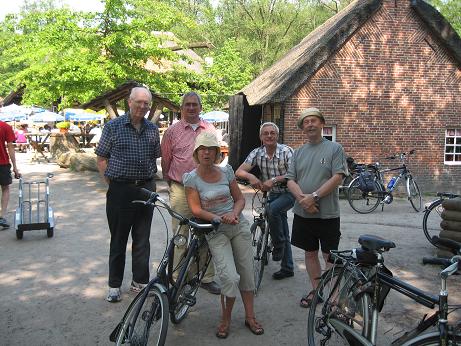
From left to right: Bruce Bolinger, A.C. de Bruyn (our host at the “In den Bockenreijder”), Anneke van Rijswijk, Ad van Rijswijk, and Kees van Kemenade. The “In den Bockenreijder” was the location of the Dutch student hideout where Allied airmen, Dutch Jews, Engelandvaarders, and others hid before being moved across the border into Belgium. It is now a popular spot for outdoor recreationists. It also features a fine memorial by the Werkgroep Heemkunde Esbeek commemorating the students and others who were part of the escape line.
In June 2011, I made another trip to National Archives II (NAII) in College Park, Maryland, the location of the escape and evasion reports of American airmen in WWII and the military intelligence files on their helpers. I spent a week there copying files and will be incorporating what I learned in the pages of this website. The information in the page on use of the Textual Research Room at NAII and the new page on Appendix Cs, part of the escape and evasion reports, already reflect this.
In May 2012 I attended the annual meeting of the Air Forces Escape and Evasion Society (AFEES) in Albuquerque, New Mexico. In late October 2012, I made another trip to National Archives II. In addition to copying Dutch and Belgian helper files, I searched American prisoner of war records I had hoped to find debriefings of members of Applewhite’s crew and airmen who were helped by the Smit-van der Heijden line but who were later captured by the Germans. However, the only POW records I found focused on war crimes.
I have posted two interviews, one of Charlotte Ambach, member of Service EVA and other Resistance groups in Brussels, and the other of Bill Bettinson, 3rd Radio Officer on the Norwegian ship “Lisbeth,” and will be adding one for Amanda Stassart, a guide for the Comet Line. An additional interview of Charlotte Ambach is to be found on the Air Forces Escape and Evasion Society website. To view it, click here.
A list of approximately 977 political prisoners on the Phantom Train/ Ghost Train is now part of the website. Click here to view it. Also on the website there is now a list of upwards of 8000 names of Dutch helpers of Allied airmen and other military personnel from a master list at the British National Archives. To see them, click here. Following that list I posted the names of approximately 2,079 Dutch helpers sorted by 74 selected cities, towns, and villages that had some connection to the Smit-van der Heijden Line. To see them, click here. In August 2012 I posted the index to approximately 16,000 helpers from Belgium and Luxembourg. To see it, click here. And to see the names sorted by seven selected Belgian cities and towns, click here. I have also posted in PDF format material from two government reports on escape and evasion:
– The entire text of It’s the Little Things
– Four parts of the M.I.S.-X Manual:
Recent additions to this website are Ed Renière’s autobiographical account of his boyhood in Brussels during WWII and Louis van den Brand’s memoirs of the same period, also in Brussels.
Visitors to this website will want to view a 44-minute Dutch documentary about the Dutch-Paris Line made in 1967. Thanks to the Weidner Foundation, it is available with English subtitles on YouTube at: http://www.youtube.com/watch?v=x96V6SiqMlc. Rarely do you get to see the helpers of people fleeing the Nazis talk about what they did. Here you do. If you are interested in the Dutch-Paris Line, be sure to read Megan Koreman’s The Escape Line: How the Ordinary Heroes of Dutch-Paris Resisted the Nazi Occupation of Western Europe, London: Oxford University Press, 2018. For more information click here.
In 2012-2014, I added a set of maps showing Belgium, France, and The Netherlands as they were in WWII. One map was prepared specifically for my use; the others were published immediately before or during the war. Click here to be connected with the maps. One of them was a 1938 map of Tilburg to Weelde, Belgium, showing the area where the Smit-van der Heijden Line was particularly active.
In December 2012 I added to the website two Frequently Asked Questions (FAQs). The first is “What Did My Father Do in the Resistance?”. The next is “How Do I Learn About an Allied Airman Who Was Shot Down But Escaped?”. Periodically I add new suggestions. These two pages may be a good place to begin for persons researching particular evaders and their helpers.
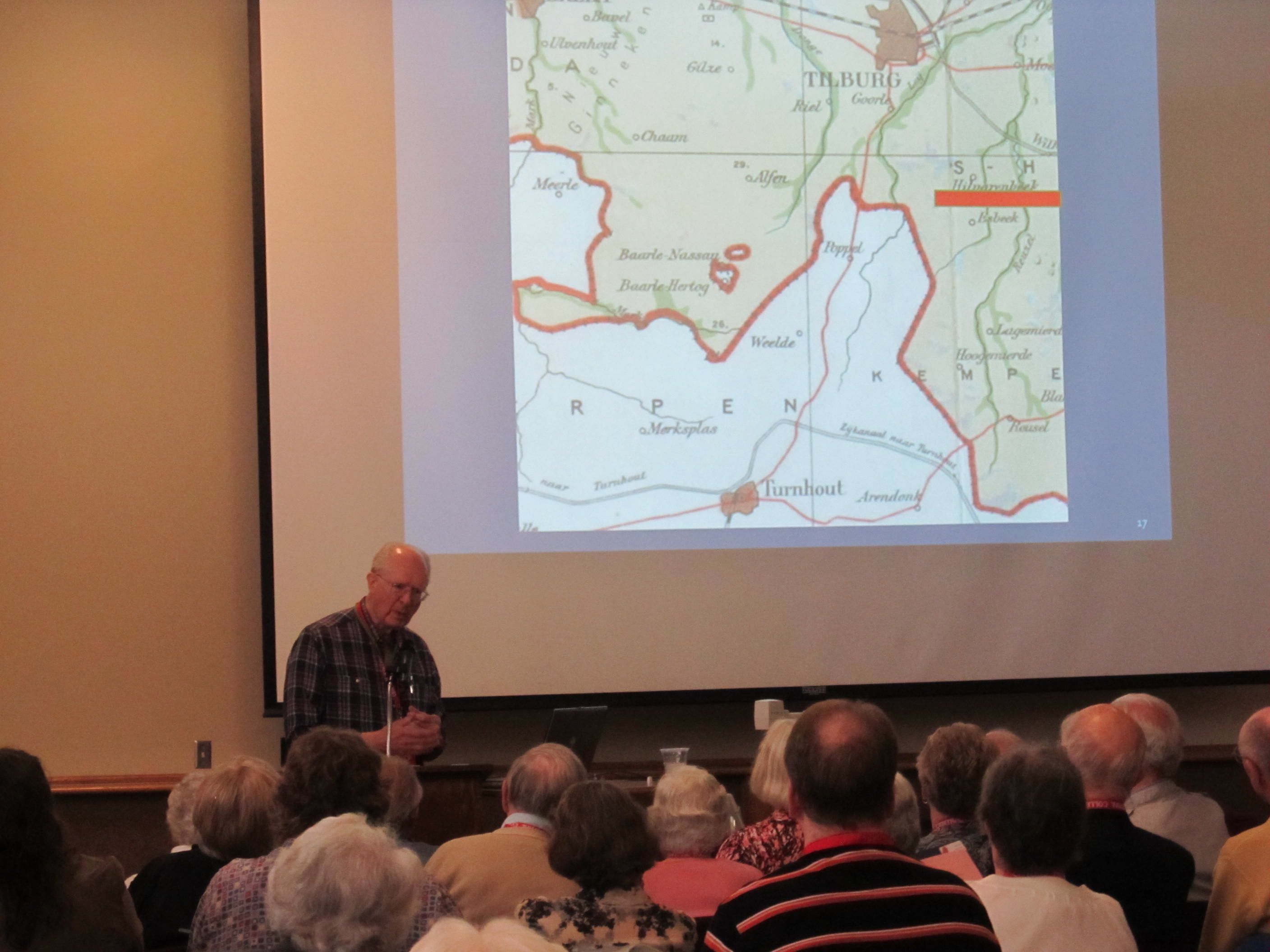
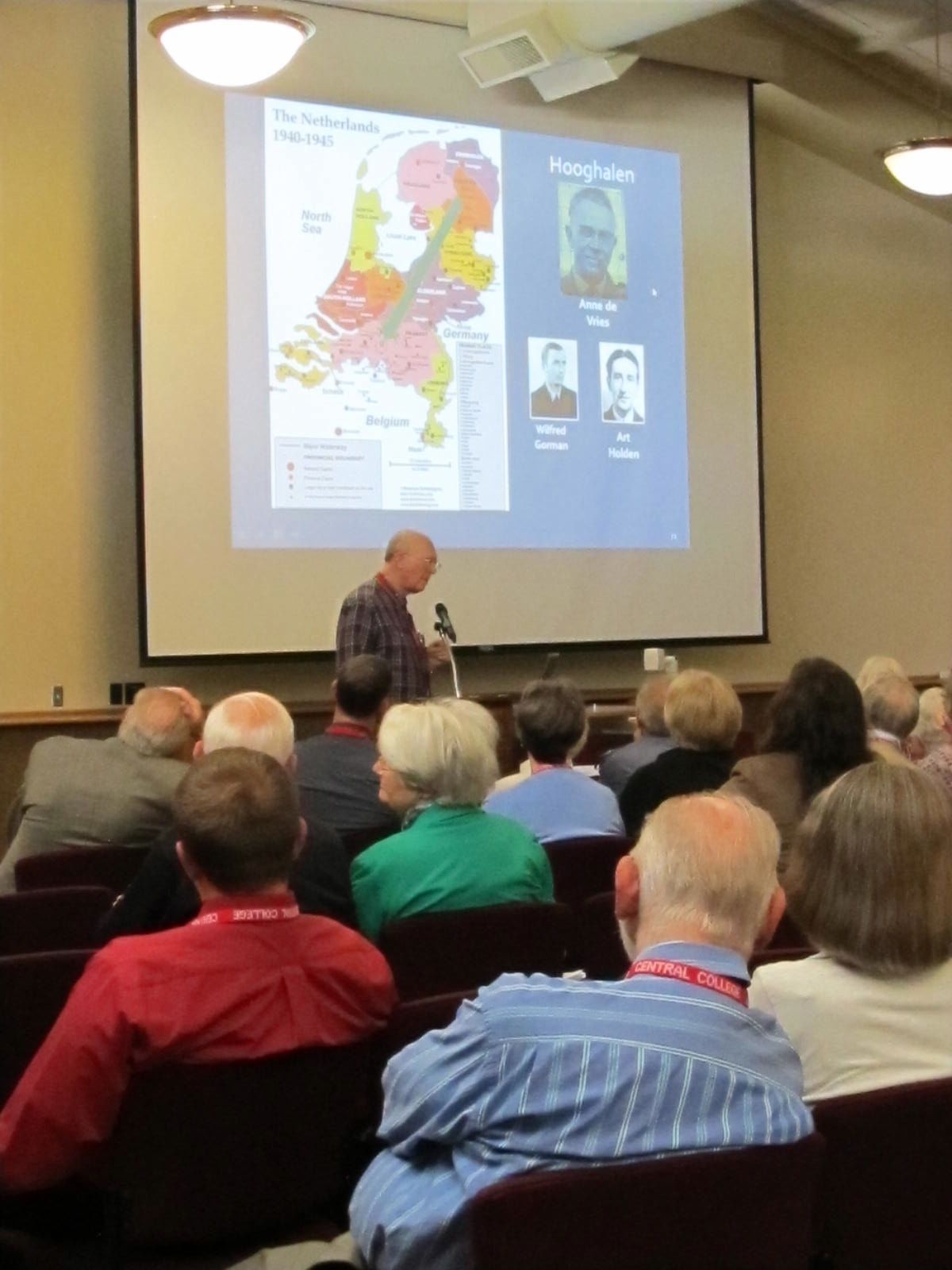
The Association for the Advancement of Dutch American Studies (AADAS) had its biennial conference at Central College, Pella, Iowa, from June 5-8, 2013 on the topic, “The Dutch-American Involvement in War: U.S. and Abroad.” There were 26 speakers. My talk was entitled, “By Trial and Error: The Experience of a Dutch Escape Line in World War II.” It seemed to be well-received. The papers were published in 2014 (for the full citation, click here). Following are a couple of photos taken by conference coordinator Lisa Zylstra during my talk. My thanks to Lisa.
From late October to Nov. 29, 2013, I added to the website the list of French men and women who helped Allied airmen as compiled by Allied Military Intelligence. The official title is Register of Helpers, I.S.9 (Awards Bureau) Paris. At the end of November I added the Danish helper list. In January 2014 I added a Hungarian helper list and a list found at the Dutch National Archives of American airmen shot down over The Netherlands who evaded capture. Starting in April 2014 and finishing in December, French researcher Franck Signorile labored to construct a database of 20,286 French helper names. He kindly shared it with this website. To view it, click here. Then he set to work on a geographical database designed so that visitors to it can see where the French helpers were living during the war. It is potentially an extremely useful tool. He finished it in February 2016. To view it, click here.
In May 2014 I attended the annual meeting of the Air Forces Escape and Evasion Society in Charleston, South Carolina and then spent a week at National Archives II in College Park, Maryland. I have begun posting on this website the various items of interest that I found plus some other material that has been submitted to me. They include: (1) Escape and Evasion Advice by Country (Denmark and Norway), (2) Life in the Dutch Underground; A Deadly Game of Hide and Seek. (3) a lecture given to U.S. troops on how to respond if taken prisoner (Lecture on Pre-Capture Training). (4) History of the Holland Office of 6801 MIS-X Detachment. [I will list the rest as I complete posting them.]
In May 2015 I attended the annual meeting of the Air Forces Escape and Evasion Society in Salt Lake City, UT and in June gave a talk on my research before the Placer County (Calif.) Genealogical Society in Auburn, CA. I gave another talk on the subject at the Oakland Aviation Museum, next to the Oakland, California, Airport, on August 2. During September 2015 I added a second list of Dutch helpers of Allied airmen that was copied at National Archives II in College Park, Maryland. To view it click here.
In September 2014 I took on responsibility as webmaster for the website of the Air Forces Escape and Evasion Society (AFEES). Initially my main concern was to convert the website to WordPress so that it would be easy to maintain. Since October 2015 I have been doing the following that may be of value to researchers:
- Posted 114 back issues of the AFEES newsletter. They contain a wealth of articles and stories about evaders and their helpers.
- Began indexing each issue of the AFEES newsletter, the indexes organized by evader, helper, place name, and other useful subjects.
- Duplicated on this website the table of contents of the AFEES website to make it easy for visitors to know and what is available on the latter.
- Posted on both websites a map of escape line routes that I had not seen before plus a map of the Dutch-Paris Line escape lines. To see them, click here.
- Posted on YouTube a DVD produced by AFEES and the Friends of the Air Force Academy Library entitled EVADE! It consists of five parts, The Movie, The Ralph Patton Story, The Life of an Underground Helper, and The Ralph Patton Collection.
- Posted on YouTube the Air War Symposium on “Escape and Evasion — The Downed Flyers Story” which took place in Louisville, KY in October 1992.
- In June 2016 I added to this website a list of Allied airmen helped by the Dutch-Paris Line.
- In August 2016 I added (1) A list of airmen helped by Groupe Hoornaert-Dirix, a Belgian organization, part of the Armee Secrete, and (2) a list of airmen helped by the Belgian Service EVA.
- In September 2016, I added a photo of the Anglo-Dutch secret agent, Dignus “Dick” Kragt (nom de guerre “Frans Hals”).
- At the end of September 2016, I added a new page with information on the Dutch Resistance Memorial Cross, including the names of the 15,000-16,000 people who were awarded it in the early 1980s.
- Starting in 2016 and continuing in 2017 I have been adding to the AFEES website memoirs and related materials of specific evaders and their helpers.
- The documentary, “Behind the Wire – Allied Airmen in Captivity in Germany“, produced by the 8th Air Force Historical Society and the RAF Bomber Command, is now available on YouTube.
- For a more complete list of enhancements to the AFEES website, click here.
A new development at the National Archives and Records Administration is that the helper files are being scanned and placed online. As of September 2016, the files for Czech and Hungarian helpers were available online. The Dutch helper files have been scanned and links set up on the Internet to access them but as of April 2020 it appeared that the files had not yet been loaded onto the Internet.
In December 2016 I was contacted by the journalist and author Christopher Dickey of the online news website, The Daily Beast, who was researching the story of Madame Elizabeth Buffet, a member of the Resistance in Paris. I shared with him what I had in the way of information on Buffet and other persons who had been in contact with her. To view the resulting article about Buffet by Mr. Dickey, entitled “Angels of the Resistance (and a Serial Killer) in Nazi-Occupied Paris,” click here. That gave me to incentive to add a great many photos to a page on this website about the evasion of Tom Applewhite now entitled “Illustrated Description of Tom’s Evasion of Capture.” To view it, click here.
In November 2017 I added a new page, the Chronology of the Smit-van der Heijden Line. Even visitors to the website who have no specific interest in that escape line might find the chronology interesting because of the impact of arrests on it and other related escape lines. Also in November, a “Bruce C Bolinger Playlist” has been created on YouTube for everything I have posted to date. These include the interviews done by the Air Forces Escape and Evasion Society with airmen shot down during WWII and helped by the Resistance and the interview with Arthur Britton, the British soldier and my cousin, who arrested Heinrich Himmler.
In October 2018, I added to the website of the Air Forces Escape and Evasion Society (AFEES) a database compiled by AFEES of information about 3000 American evaders during WWII. They include entries not only about evaders in northwest Europe, the main focus of AFEES, but also China and the Balkans. I added an index to the names of the evaders in the database to make searches easier. To view the index and the database, click here.
Currently (late 2018 to 2020) I and another member of AFEES have been working on indexing the newsletters of the Air Forces Escape and Evasion Society (AFEES) to make it easy for visitors to their website to find articles about evading airmen and their helpers that were published in the newsletters from 1969 to the present. The following are the links to the newsletters, the index of the evaders, the index of their helpers, and the index to other subjects.
As of March 2019, there is a new escape and evasion story on the website. Thanks to author Peter Elliott, readers now can enjoy Chippy Robinson: a Paratrooper’s Story of Escape After the Battle of Arnhem.
Other new features of the website of the Air Forces Escape and Evasion Society (AFEES) are: (1) several complete books on escape and evasion that have been scanned and posted on the website, (2) a section specifically on escape and evasion research, (3) a new section on current events involving AFEES members, including information about escape and evasion activities of other organizations, and (4) a PowerPoint talk given at the 2019 AFEES reunion on the general subject of escape and evasion. One of the complete books on the AFEES website is In the Shadow of the Swastika, The Double Life of a Resistance Leader in World War II Occupied Holland by Hendrik van Remmerden. Another is Stepping Stones to Freedom: Help to Allied Airmen in The Netherlands During World War II by Professor Bob de Graaff.
In early January 2020 I donated all my WWII escape line research files (47 linear feet) to the McDermott Library at the Air Force Academy in Colorado Springs, Colorado. I wanted to ensure that they would be available to the public for research after I am gone. To be known as the Bolinger Collection, they will join other WWII escape and evasion collections at McDermott, one of which is the Ralph Patton Collection. A description of the Bolinger collection appears in the following pdf file: Finding Aid_MS 71-Bolinger, Bruce. The Ralph Patton Collection appears in the following pdf fie: Finding Aid MS 54-Ralph Patton Manuscript Record. In the meantime I will continue my interest in the subject, will maintain this website, and will respond to requests for help from members of the public seeking to learn more about family members who were either airmen shot down during WWII or people of the occupied countries who helped them.
Thanks to Jaap de Boer who brought its availability to my attention, I have added links to another useful tool, a list of Netherlands Grade V, Eisenhower Certificates, available on-line, courtesy of the National Archives. It consists of 187 pages with 4,870 names and addresses of Dutch helpers compiled in late 1946 and early 1947.
In February 2020 I added several documents to the Smit-van der Heijden Line part of this website. They include an interview with Karst Smit by Baarle-Nassau Radio, a report by him written in 1945, an interview with him by me in 2002, five articles written by Eugene van der Heijden plus an obituary article about him by Jan Naaijkens as well as a 1994 Verzetsmuseum interview with him, a 1963 letter by Karst Smit “Hilvarenbeek and the Pilot Route”, and a 1947 report by the Tilburg police.
On July 17, 2021, I posted an article that I wrote, Evaders and Oranges, The Seville Escape Route. To view it, click here.
There are so many links in this website to other websites that, inevitably, some will be defunct. Please notify me of any inoperative links, provide the pages where they appear and which links they are, and I will try to correct them promptly. Click here for how to get in touch with me.
In November 2021 I learned of plans for a concert in the vicinity of the village of Well, The Netherlands, in memory of Tom Applewhite and the helper who hid him for several nights, Peek de Noo. The announcement appears here.
 WWII Netherlands Escape Lines